


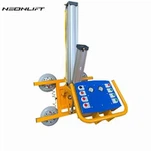
Glass Vacuum Lifter Robot
Send Inquiry
Since the introduction of glass handling and lifting robots, safe lifting and installation of glass panels has become a reliable reality. Manual glass installation carries significant risks, including panel breakage, cracks, and serious worker injuries.
Glass lifting robots have emerged as the ideal solution for safe, efficient glass handling operations.
Common Challenges in Glass Handling for Glass Factories
High Breakage Rates and Material Waste
Large glass sheets are fragile, heavy, and slippery. Manual handling often leads to cracks, chips, scratches, and breakage, resulting in high material waste, increased costs, and delayed production.
Glass vacuum lifter robots use powerful, evenly distributed vacuum suction to securely hold glass panels without damage. Its max capacity can reach to 800kg. This greatly reduces human error and physical impact, drastically lowering breakage rates.
Low Handling Efficiency and Production Bottlenecks
Moving large glass manually requires multiple workers, has slow speed, and poor coordination. This creates bottlenecks in processing lines including cutting, edging, cleaning, tempering, and packaging.
One single operator can control the vacuum lifter to load, transfer, and position glass sheets efficiently. This stabilizes workflow, shortens cycle times, and eliminates bottlenecks across the production line.
High Risk of Worker Injuries and Production Downtime
Workers face serious risks such as muscle strains, hand injuries, falls, and even glass breakage-related accidents. Injuries lead to absenteeism, downtime, compensation costs, and unstable output.
Vacuum lifter bear the full weight of glass panels. Workers only need to operate the controls remotely or on-site, greatly reducing physical labor and injury risks, ensuring stable staffing and continuous production.
Difficulty in Precise Positioning
Manual movement and alignment are inaccurate, causing repeated adjustments, machine loading errors, and low efficiency in processing and packaging.
Vacuum lifting robots support flexible adjustments including side-shift, rotation, and tilting, enabling fast and precise positioning. This reduces rework and improves compatibility with automated production lines.
|
Model
|
DXGL-LD 300
|
DXGL-LD 400
|
DXGL-LD 500
|
DXGL-LD 600
|
DXGL-LD 800
|
|
Capacity(kg)
|
300kg (retract)
150kg (extend)
|
400kg (retract)
200kg (extend)
|
500kg (retract)
250kg (extend)
|
600kg (retract)
300kg (extend)
|
800kg (retract)
400kg (extend)
|
|
Manual rotation
|
360°
|
360°
|
360°
|
360°
|
360°
|
|
Max lifting height(mm)
|
3500
|
3500
|
3500
|
3500
|
5000
|
|
Operation method
|
walking style
|
walking style
|
walking style
|
walking style
|
walking style
|
|
Battery(V/A)
|
2*12/100
|
2*12/100
|
2*12/100
|
2*12/100
|
2*12/120
|
|
Charger(V/A)
|
24/12
|
24/15
|
24/15
|
24/15
|
24/18
|
|
walk motor(V/W)
|
24/1200
|
24/1200
|
24/1500
|
24/1500
|
24/1500
|
|
Lift motor(V/W)
|
24/2000
|
24/2000
|
24/2200
|
24/2200
|
24/2200
|
|
Front wheel size(mm)
|
Ø400*80
|
Ø400*80
|
Ø400*90
|
Ø400*90
|
Ø400*90
|
|
Rear wheel size(mm)
|
Ø250*80
|
Ø250*80
|
Ø300*100
|
Ø300*100
|
Ø300*100
|
|
Suction cup size(mm)
|
Ø300
|
Ø300
|
Ø300
|
Ø300
|
Ø300
|
|
Suction cup quantity
|
4 pcs
|
4 pcs
|
6 pcs
|
6 pcs
|
8 pcs
|
|
Packing size(mm)
|
2560*1030*1700
|
2560*1030*1700
|
2580*1050*1700
|
2580*1050*1700
|
3000*1250*2300
|
|
Weight
|
1150kg
|
1330kg
|
1350kg
|
1450kg
|
1650kg
|
|
Movement |
Automatic |
1. Pad frame vertical up/down 180°automatic 2. Boom in/out TELESCOPIC automatic 3. Powered arm up/down automatic 4. Lateral side shift left/right 100mm automatic |
|||
|
Manual |
5. Pad frame tilt left/right 90°manual (extra cost to change to automatic) 6. Pad frame rotation 360°manual (extra cost to change to automatic) |
||||
How Vacuum Lifter Robots Boost Efficiency in Glass Factories
Reduce Labor Dependency and Lower Operating Costs
Traditional glass handling relies on 3–6 people per sheet, leading to high labor costs, low efficiency, and difficulty in recruiting skilled workers.
One worker with a vacuum lifter can complete tasks that previously required an entire team. This significantly cuts labor costs while improving handling capacity and stability.
Accelerate Production Line Speed and Throughput
Slow manual loading and unloading cause frequent interruptions, limiting daily output and factory capacity.
Glass vacuum robots enable fast, smooth loading and unloading between processing stages. This keeps the entire production line running continuously and increases daily output significantly.
Improve Workplace Safety and Reduce Downtime
Accidents and injuries lead to shutdowns, fines, extra training, and low employee morale.
By minimizing direct manual contact with heavy glass, the robots create a safer working environment, reduce accident rates, and maintain consistent production without unexpected downtime.
Enhance Positioning Accuracy and Reduce Rework
Inaccurate placement causes misprocessing, defective products, and wasted materials and time.
With precise movement control, vacuum lifters ensure accurate alignment during loading, processing, and packaging. This reduces defects, rework, and material waste.
Handle Large, Heavy, and Oversized Glass Safely
Manual handling of large-format, thick, or heavy glass is extremely difficult and risky, limiting product types and factory capabilities.
Glass vacuum lifter can safely lift and transport large, heavy, and oversized glass sheets that workers cannot handle manually, expanding production capacity and product range.

You May Also Like



Send Inquiry
Categories
Latest Products


Contact Us
- Tel: +86-15192782747
- Email: sales@neonlift.com
- Add: Shouchuang Industry Park, Qingdao, China