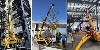
For general contractors, engineering enterprises and equipment rental firms, lifting equipment serves as a core asset to control construction progress and define project completion timelines. Within the construction workflow of industrial and commercial building projects, lifting operations represent key milestones running from main structure completion through final project acceptance, directly shaping the overall construction rhythm. The standard industry construction sequence follows a clear path: main building structure handover, lifting equipment mobilization, precise positioning of steel structures and glass panels, curtain wall installation and structural fastening, interior fit-out and MEP system commissioning, and final project handover and acceptance. Any delay in crane delivery will halt all subsequent processes including glass curtain wall erection, steel structure fitting, industrial equipment maintenance and rooftop HVAC installation. This creates cascading schedule overruns, resulting in substantial site shutdown losses, idle labour expenses and equipment standby fees.
Amid today's volatile global supply chain and persistent uncertainties, long lead times and unpredictable delivery schedules for custom lifting machinery have become major bottlenecks slowing project execution. Against this industry backdrop, this article analyses how the delivery cycle of spider cranes impacts construction scheduling, cost control and overall project profitability. It also explains why ready-to-use spider cranes deliver a strategic solution for modern contractors to stabilise work sequences, mitigate schedule risks, cut total expenditure and boost operational productivity.
1. Multiple Project Risks Caused by Delayed Equipment Delivery
1.1 Disrupted site logistics and wasted equipment performance benefits
Mini crawler cranes, also known as spider cranes, feature compact dimensions and strong site accessibility. They operate effectively in indoor venues, confined construction zones, narrow corridors and finished commercial buildings where large lifting machinery cannot access, making them essential for precision construction work. However, these performance advantages only deliver value with on-time delivery. If shipment is postponed, the machine's compact footprint and rapid deployment capability cannot be leveraged. Stock units enable fast site mobilisation, reduce material handling delays, eliminate extra work from secondary transfers, simplify cross-trade coordination between heavy machinery and on-site activities, and maintain smooth site material logistics.
1.2 Conflicting subcontractor workflows and increased project coordination complexity
Modern building projects rely on multi-team collaboration, involving steelwork crews, curtain wall installers, MEP and electrical subcontractors. Each task is tightly sequenced with interdependent deadlines. Late lifting equipment delivery not only stops lifting activities, but triggers cascading construction conflicts: disrupted subcontractor schedules, delayed elevated work permit approvals, disconnected transport plans and construction sequences. This raises project coordination hazards and management burdens. A stable stock delivery framework minimises project uncertainty at the source and supports seamless multi-team operations.
1.3 Hidden costs that erode project profit margins
As critical-path site machinery, even short delivery delays trigger wide-ranging financial losses. Taking a typical 60-day equipment delay as an example, projects face irreversible cost impacts: overall project kickoff is pushed back, key construction milestones slip and total project duration extends. Multiple work crews remain idle, generating wasted labour expenditure and squeezing project profit. Rental periods for forklifts and aerial work platforms must be extended, bringing extra leasing charges. Missed handover deadlines may activate contractual penalty clauses and incur large liquidated damages. Project management teams spend extra hours rescheduling, liaising with suppliers and coordinating crews, driving up administrative overhead. Tied-up project resources also prevent firms from bidding on new contracts and capturing fresh business opportunities. For medium and large commercial and industrial developments, hidden losses from equipment delays frequently outweigh the price difference between equipment suppliers.
2. Core Operational Benefits of Mini Crawler Cranes
2.1 Secure construction schedules and avoid timeline overruns
Supported by mature factory stock availability, all standard mini crawler crane models are pre-assembled and fully tested. Buyers can reserve available units quickly. Once stock availability is confirmed, logistics arrangements can start immediately. This removes the industry pain point of unpredictable lead times, enabling precise schedule management. The machines respond well to urgent repairs, accelerated short-term builds and emergency equipment replacement scenarios, securing project windows and keeping construction on track.
2.2 Site-ready operation to cut preparation lead times
All spider cranes go through a complete standard pre-shipment inspection process before leaving the factory. Checks include weld strength verification, full-load performance testing, hydraulic pressure calibration, proportional valve tuning, accurate load moment indicator calibration and full-function simulation trials to eliminate factory defects. After arrival on site, no complex disassembly or commissioning is required. Minimal on-site preparation enables fast deployment and operation, shortening the interval between machine arrival and active lifting work to achieve site-ready performance.
2.3 Lower project costs and prevent extra financial losses
Fast mobilisation and commissioning help organisations avoid expenses linked to schedule slippage. It minimises downtime, idle labour and extended equipment rental fees, reduces contractual penalties from late completion and cuts management overhead from emergency schedule adjustments and multi-party coordination. Total operational costs are optimised across equipment procurement, site execution and progress management to preserve project profit margins.
2.4 Comprehensive after-sales support to reduce downtime risks
A full stock of original spare parts covers consumables and core components to deliver fast global response for equipment repairs and component replacement, shortening maintenance downtime. Professional technical teams provide remote guidance and on-site after-sales services, backed by a 12-month full machine warranty. The system supports stable and reliable lifting performance across the full equipment lifecycle for construction projects worldwide.
2.5 Empower business growth and strengthen market competitiveness
For engineering contractors and equipment rental operators, access to ready lifting machinery is not merely an operational advantage, but a key competitive edge. When facing urgent site demands, tight-deadline projects and fast mobilisation requirements, the ability to supply immediately operable lifting solutions supports reliable contract fulfilment, builds client trust and unlocks more business opportunities.
3. Robust Machine Performance for Harsh All-scenario Construction
Stock availability protects timelines, while industrial-grade quality underpins long-term stable operation. All mini crawler cranes are engineered to industrial standards and suitable for confined indoor spaces, outdoor high-level lifting, precision equipment hoisting and curtain wall installation across complex and demanding working environments.
3.1 High-strength structure and precision hydraulics for safe, accurate lifting
Booms are manufactured from high-strength manganese steel, balancing lightweight design, strong bending resistance and fatigue endurance for frequent heavy lifting cycles. Equipped with proportional hydraulic manifolds and wireless proportional control systems, the machines deliver fine lifting adjustments for smooth, precise handling. This suits fragile, high-tolerance lifting tasks such as glass curtain wall and precision steel component installation. Wide rubber track undercarriages distribute ground pressure evenly, allowing safe movement across finished floor slabs, shopping mall surfaces and indoor flooring without surface damage. A 360° continuous slewing platform delivers unrestricted working coverage for complex construction sites.
3.2 Multi-power options for diverse construction environments
Multiple power configurations meet environmental and power requirements across different job sites. Battery-electric versions use 48V lithium battery packs supporting 6–8 hours of continuous operation per full charge, with zero emissions and ultra-low noise. Mains power connection enables non-stop operation, ideal for data centres, hospitals, premium commercial venues and clean workshops with strict environmental requirements. Dual-power models combining diesel or petrol power with electric drive deliver heavy-duty outdoor performance alongside low-emission indoor operation. Operators can switch power modes freely according to site conditions for maximum working flexibility.
3.3 Intelligent safety protection to mitigate construction hazards
All models feature mature integrated safety systems including real-time load moment monitoring, three-mode safety interlocks, anti-tipping alarms, emergency stop buttons and level sensors. The system continuously monitors lifting loads and outrigger forces. It automatically locks hazardous operations when approaching safety thresholds to prevent overload and overturning incidents and fully complies with construction safety standards. Four independently adjustable hydraulic outriggers adapt to uneven ground, sloped terrain and narrow working zones for enhanced stability and safety in difficult working conditions.
4. End-to-end Customised Services to Guarantee Project Delivery
Construction projects cannot afford schedule delays caused by equipment supply issues. Reserving spider cranes ahead of project kickoff provides solid protection for construction timelines. The mini crawler crane service package delivers end-to-end bespoke support: real-time stock and model checks, custom equipment selection matched to site conditions, pre-shipment factory test video verification and tailored logistics planning for fastest delivery.
For urgent project requirements, the system rapidly responds to emergency equipment replacement, crash schedules, fleet expansion and peak season demand. Once agreements are finalised, final inspection, reinforced packing and export customs and logistics procedures start without delay. Leveraging extensive export logistics experience and efficient inventory management, lead times are minimised to help construction projects stabilise schedules, cut costs and boost efficiency.