The integration of advanced technologies in industrial settings has revolutionized the way businesses operate. Among the various tools and equipment that have emerged as game - changers, rotary platforms stand out as versatile components that hold significant potential for industrial automation. As a rotary platform supplier, I have witnessed firsthand the diverse applications and benefits these platforms bring to the industrial landscape.


Understanding Rotary Platforms
Rotary platforms, also known as turntables, are mechanical devices that enable circular motion. They typically consist of a flat surface that can rotate around a central axis, driven by various power sources such as electric motors, hydraulic or pneumatic systems. The rotation can be continuous or intermittent, with precise control over speed, direction, and angle of rotation.
The design of rotary platforms can vary widely depending on their intended applications. Some are small and lightweight, suitable for use in laboratory or small - scale manufacturing environments. Others are large and heavy - duty, capable of supporting substantial loads in industrial settings.
Applications of Rotary Platforms in Industrial Automation
Material Handling
One of the most common applications of rotary platforms in industrial automation is material handling. In manufacturing plants, rotary platforms can be used to move products along an assembly line. For example, a product can be placed on a rotary platform at one station, rotated to the next station for a specific operation such as drilling, welding, or painting, and then moved on to subsequent stations. This reduces the need for manual handling, increases efficiency, and improves the accuracy of the manufacturing process.
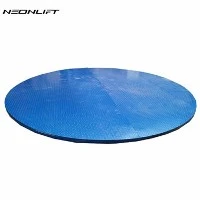
Our Vehicle Rotating Platform is a prime example of a rotary platform used in a specific material - handling context. In automotive manufacturing or parking facilities, this platform allows vehicles to be rotated easily, facilitating tasks such as loading, unloading, and parking in tight spaces.
Assembly Operations
Rotary platforms play a crucial role in assembly operations. They can hold multiple parts in place and rotate them to the correct position for assembly. For instance, in the electronics industry, small components need to be precisely assembled onto a circuit board. A rotary platform can be programmed to rotate the circuit board to the exact angle required for each component to be placed accurately, ensuring high - quality assembly and reducing the risk of errors.
Inspection and Testing
Industrial automation often requires thorough inspection and testing of products. Rotary platforms can be used to rotate products during these processes, allowing for 360 - degree inspection. Sensors and cameras can be positioned around the platform to detect any defects or irregularities on the product's surface. For example, in the food and beverage industry, bottles can be placed on a rotary platform and rotated while being inspected for proper labeling, fill levels, and any signs of contamination.
Display and Presentation
In industrial trade shows and exhibitions, Rotating Display Platform are used to showcase products in an attractive and dynamic way. These platforms can rotate products slowly, allowing visitors to view all sides of the product without having to move around it. This not only enhances the visual appeal of the display but also provides a better understanding of the product's features and functionality.
Advantages of Using Rotary Platforms in Industrial Automation
Increased Efficiency
By automating tasks that would otherwise be performed manually, rotary platforms significantly increase the speed of industrial processes. The ability to precisely control the rotation speed and angle means that operations can be carried out in a more streamlined manner, reducing the time required for each task and increasing overall productivity.
Improved Accuracy
Rotary platforms offer high - precision movement, which is crucial in many industrial applications. Whether it's placing components during assembly or inspecting products for defects, the accurate rotation provided by these platforms ensures that tasks are performed with a high degree of accuracy, leading to better - quality products.
Flexibility
Rotary platforms can be easily integrated into existing industrial automation systems. They can be customized to meet the specific requirements of different applications, such as load capacity, rotation speed, and control options. This flexibility makes them a valuable asset in a wide range of industries.
Space Optimization
In industrial settings where space is often limited, rotary platforms can help optimize the use of available space. For example, the Turntable Car Lift allows vehicles to be rotated and lifted in a compact area, making it possible to park more cars in a given space.
Challenges and Considerations
Cost
The initial investment in rotary platforms can be relatively high, especially for heavy - duty and high - precision models. However, it's important to consider the long - term benefits, such as increased efficiency and productivity, which can offset the initial cost over time.
Maintenance
Like any mechanical device, rotary platforms require regular maintenance to ensure optimal performance. This includes lubrication, inspection of moving parts, and calibration of control systems. Proper maintenance can extend the lifespan of the platform and prevent costly breakdowns.
Compatibility
When integrating rotary platforms into an existing industrial automation system, compatibility issues may arise. It's essential to ensure that the platform is compatible with other components of the system, such as sensors, controllers, and actuators.
Case Studies
Let's take a look at some real - world examples of how rotary platforms have been successfully used in industrial automation.
In a large automotive manufacturing plant, the use of Electric Motorized Stage Car Turntable has streamlined the production process. The turntables are used to rotate cars during various assembly and painting processes. This has reduced the need for manual repositioning of the vehicles, resulting in a significant increase in production speed and a decrease in labor costs.
In a consumer electronics factory, rotary platforms are used for the assembly of smartphones. The platforms hold the phone frames and rotate them to the correct position for the insertion of components such as cameras, batteries, and circuit boards. The high - precision rotation of the platforms ensures that the components are assembled accurately, leading to a higher - quality end product.
Future Trends
The future of rotary platforms in industrial automation looks promising. With the advancement of technologies such as the Internet of Things (IoT) and artificial intelligence, rotary platforms are likely to become even more intelligent and integrated into industrial systems. For example, IoT - enabled rotary platforms can collect data on their performance, such as rotation speed, load capacity, and energy consumption. This data can be analyzed to optimize the operation of the platform and predict maintenance needs.
In addition, the development of more compact and lightweight rotary platforms will make them more accessible for small - and medium - sized enterprises. These platforms will offer the same level of performance and precision as larger models, but at a lower cost and with less space requirements.
Conclusion
In conclusion, rotary platforms can indeed be effectively used for industrial automation. Their versatility, efficiency, and accuracy make them valuable assets in a wide range of industrial applications, from material handling and assembly to inspection and display. While there are challenges such as cost and maintenance, the benefits far outweigh the drawbacks.
As a rotary platform supplier, we are committed to providing high - quality products and services to meet the diverse needs of our customers in the industrial automation sector. Our Rotating Display Stage and other rotary platform products are designed to offer the best performance and reliability.
If you are interested in exploring how our rotary platforms can enhance your industrial automation processes, we invite you to contact us to discuss your specific requirements and start a procurement negotiation. We look forward to working with you to achieve your industrial automation goals.
References
- "Industrial Automation Handbook", John Wiley & Sons
- "Automation, Production Systems, and Computer - Integrated Manufacturing", Prentice Hall
- Industry reports on industrial automation trends and technologies