Let me start by saying something I hear all the time as a boom lift supplier: “Confined spaces are our bread and butter—we just need a reliable aerial lift to get the job done.” For years, that made total sense. After all, boom lifts are designed to reach high, hard-to-access areas, so it’s easy to assume any model will work in tight quarters. But over the past decade, I’ve seen way too many projects derail because a boom lift that looked good on paper couldn’t cut it in a confined space—and those mistakes don’t just cost time; they cost money, and sometimes, they create serious safety hazards. Today, I want to break down the real limitations of using a standard boom lift in a confined space, share the lessons we’ve learned from working with construction, maintenance, and industrial teams, and point you to the right solutions if tight spaces are part of your work.
First, let’s get clear on what we mean by a confined space, because this isn’t just “a small garage” or “a tight warehouse aisle.” OSHA defines a confined space as any area that’s large enough and configured so an employee can bodily enter it, has limited or restricted means for entry or exit, and is not designed for continuous employee occupancy. That includes things like interior industrial piping areas, manufacturing plant mezzanines with narrow access, basement utility works, stadium upper-deck repairs, and even shipbuilding compartments. These spaces aren’t just small—they have low overhead clearance, narrow access points, immovable obstacles, uneven flooring, and often, other crews or equipment already in the area. Standard boom lifts, the ones most people rent off the shelf, aren’t built to adapt to these unique constraints, and that’s where the problems start.
The first, most obvious limitation is horizontal reach and maneuverability. Most standard articulated boom lifts are built for open worksites: wide construction lots, outdoor event venues, or tall warehouse bays where there’s room to swing the boom and rotate the chassis. In a confined space, even a seemingly small overhang from the boom’s rotating jib can hit a ceiling duct, a sprinkler line, or a structural beam before the operator even gets to the work area. I remember a restaurant chain client who was repainting their ceiling in a 1,200-square-foot dining room. They rented a 40-foot articulated boom lift from a local equipment yard, thinking it would fit through the 6-foot-wide back delivery door. It fit through the door, but once inside, they couldn’t move it 10 feet forward without the jib catching on the HVAC duct running along the ceiling. They spent 2 hours trying to reposition it, and by then, they’d fallen behind schedule and had to pay overtime for their painting crew. That’s not a rare story. Standard booms typically have chassis widths of 3 to 5 feet, and their rotating turntables require a clear swing radius of 10 to 15 feet around the base. In a confined space, that’s a luxury most teams don’t have.
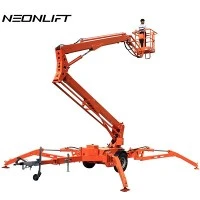
Wait, you might be thinking—what about trailer-mounted lifts? Those are smaller, right? Well, trailer man lifts do have compact chassis designs, which is a plus, but they have their own set of limitations in tight spaces. Trailer man lifts are towed to the site, so their design folds up into a narrow form factor for transport, but when deployed, they need a stable flat surface to extend and rotate. In a confined space, that stable surface is often hard to come by. I worked with a mechanical contractor who was servicing piping in a 3-foot-deep basement utility trench. They brought in a trailer man lift, but the basement floor had sloped concrete around the trench, and when they extended the lift 25 feet, the unstable base made it tip slightly, triggering the lift’s safety lock and shutting it down. It took them a whole day to re-level the trailer with temporary wood blocks, and even then, the lift couldn’t reach the far end of the trench because its horizontal reach was limited by the trailer’s fixed base. If you’re working in a space with uneven or unstable ground, even a compact trailer man lift might not be the answer, because you can’t deploy it without clear, level ground.
Another big issue is height clearance, both overhead and undercarriage. Confined spaces often have extremely low overhead limits, especially if you’re working inside an existing structure. A standard telescopic boom lift, for example, has a tall retracted chassis—some models are 7 feet high when folded. If you’re trying to work in a mezzanine with a 8-foot overhead clearance, that’s a tight fit, but if you need to go higher, extending the boom adds another 20 to 40 feet of height, so the combined overhead footprint becomes impossible. Even articulated booms, which fold into a more compact form, have hinged sections that can catch on ceilings or overhead utilities. I’ve seen a manufacturing plant shut down an entire production line because a boom lift’s boom hit a high-voltage cable running above a narrow aisle, causing a power surge that fried two control panels. That’s not just a delay—it’s a costly safety incident and equipment damage.
Then there’s navigation through narrow access points and tight turns. Many confined spaces require the lift to be moved through doorways, hallway intersections, or corridor turns that are barely wider than the lift itself. Standard booms have long wheelbases, so turning requires extra space to swing the back end around corners. In a 4-foot-wide hallway, that means the lift’s rear tire will hit the wall unless the operator is extremely careful, and even then, repeated turns can scratch or damage the structure. I learned this lesson first-hand with a retail client who was installing signage along a 30-foot-long, 4.5-foot-wide hallway in a mall. They rented a standard towable articulated boom lift, which was 48 inches wide. When they tried to turn it at the end of the hallway, the rear wheel scraped the polished tile wall, leaving a $1,200 scratch mark that the mall charged them to repair. If the lift had been a more compact model, it could have made that turn without damage.
Power and accessibility are also bigger challenges than most teams expect. A lot of confined spaces—especially older industrial buildings, basements, or ship compartments—have limited electrical outlets, bad ventilation, or no access to fuel lines for gas-powered lifts. Gas and diesel boom lifts emit exhaust fumes, which can build up quickly in a confined space and create a respiratory hazard for operators and other crew members. Electric models are a better choice here, but standard electric articulated booms require external power cords or battery charges that might not last through a full shift in a tight space, and their cords can get tangled in overhead obstacles. I worked with a maintenance team at a local hospital that was repairing lights in their utility tunnel, which was only 6 feet high and 5 feet wide. They brought in a standard electric articulated lift, but the 100-foot power cord didn’t reach the only outlet at the tunnel entrance, so they had to use a generator, which made the space even hotter and more stifling, adding to the risk of heat exhaustion for the operator.
Wait, but don’t worry—this isn’t a “boom lifts are useless in confined spaces” rant. As a boom lift supplier, we’ve seen that when you pick the right model, boom lifts can work perfectly well in tight spaces. That’s why we built specialized options tailored for these exact scenarios. For example, our industrial mobile spider boom lift is designed specifically for confined spaces. It has a compact, low-profile chassis that’s only 2.5 feet wide when folded, so it can fit through most standard 3-foot-wide doorways. Its tracked base lets it navigate uneven, sloped, or soft ground without tipping, which is perfect for basements or utility trenches. And its rotating, collapsible boom sections have a narrow swing radius, so it can reach areas that would be impossible for a standard boom. If you’re working in a space with extremely limited maneuverability, the industrial mobile spider boom lift is a game-changer.
For teams that need something a bit more powerful but still compact, our trailer man lift models are optimized for stability in tight, level spaces. Unlike standard trailers, these models have a lower center of gravity and built-in leveling jacks that adjust automatically on uneven ground, so you don’t have to waste time stacking wood blocks to stabilize the lift. And our towable articulated boom lift line has a narrow chassis (under 4 feet wide) and a reduced swing radius, making it easier to maneuver through hallway turns and narrow access points. We also have electric options, like our electric articulated aerial work platform, which is zero-emission, so it’s safe to use in enclosed spaces with poor ventilation. For longer-term hire projects, our electric telescopic boom lift hire models are designed with low overhead clearance in mind, with a retracted height of just 6.5 feet and a compact footprint that fits through most interior doorways.
But before you rush to rent or buy any boom lift for a confined space, there are a few key things you need to check to avoid the mistakes I’ve seen play out hundreds of times. First, measure every access point, overhead clearance, and navigation path before you choose a lift. Don’t just guess—use a tape measure and account for any obstacles like ceiling ducts, pipes, or structural beams that might be in the work area. Second, check the ground condition: is it level? Is it soft dirt or concrete? If it’s uneven or soft, a tracked spider lift will work better than a wheeled boom or trailer. Third, assess ventilation and power: if the space is enclosed or has bad airflow, skip gas/diesel models and go electric. And finally, make sure the lift’s horizontal reach is long enough to cover your work area without needing to reposition the base too many times—too much repositioning wastes time and increases the risk of accidents.


Another critical point that many teams overlook: operator training for confined spaces isn’t the same as standard boom lift training. Even if your operator is certified to run a boom lift on an open worksite, they need specialized training for confined spaces, because the risks are different. They have to be aware of overhead obstacles at all times, they need to know how to navigate tight turns without damaging structures, and they have to understand the hazards of exhaust fumes and limited entry/exit points. I’ve seen even experienced operators make mistakes because they weren’t trained for confined space scenarios—like extending a boom too far and hitting an obstacle, which can cause the lift to sway or tip.
Over the past 15 years, as more construction and industrial projects have moved into tighter, more constrained spaces, we’ve worked with hundreds of teams to match them with the right lift for their needs. The biggest mistake we see is assuming that “a boom lift is a boom lift” and grabbing the cheapest or most readily available model. Confined spaces demand a lift that’s built for maneuverability, compactness, and adaptability—not just height reach. The models we’ve developed, from the industrial mobile spider boom lift to our electric articulating aerial work platforms, are all designed to solve the exact limitations I’ve outlined today, because we’ve learned those lessons alongside our customers.
If you’re working on a project in a confined space and you’re not sure which lift is right for you, don’t hesitate to reach out. Every project is different, and we’re here to help you evaluate your space, your work requirements, and your budget to find a solution that works. We don’t believe in one-size-fits-all solutions, especially when it comes to aerial work in tight quarters.
References:
- Occupational Safety and Health Administration (OSHA). (2023). Confined Space Standard: 29 CFR 1915 Subpart A. U.S. Department of Labor.
- International Organization for Standardization (ISO). (2021). Standard for Aerial Work Platforms: Safety Requirements for Confined Space Operation. ISO 16098:2021.
- National Association of Equipment Rental Companies (NAERC). (2022). 2022 Equipment Rental Trends: Confined Space Aerial Lift Usage Report. NAERC.
- European Agency for Safety and Health at Work (EU-OSHA). (2020). Risk Assessment for Aerial Work in Confined Spaces. EU-OSHA Publication.