When you’re sourcing material handling equipment for your warehouse, manufacturing floor, or distribution center, lift tables might seem like a one-size-fits-all solution at first glance. But as a lift table supplier who’s fielded hundreds of questions from clients over the past decade, I can tell you that the gap between a simple lift table and a complex lift table design is the difference between a tool that gets the job done and one that can elevate (pun intended) your entire operation’s efficiency, safety, and flexibility.
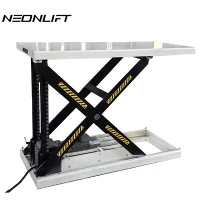
Let’s start with the basics: a simple lift table is built for straightforward, repetitive tasks. Most of the time, these are hydraulic scissor lift tables with a single set of scissors, a basic power unit, and a fixed load capacity, usually under 2,000 pounds. They’re compact, low-cost, and easy to install—perfect for small workshops or businesses that only need to adjust pallet heights a few times a day. Think of a small auto repair shop that uses a lift table to move engine blocks between workbenches; it doesn’t need to reach extreme heights or handle oversized loads, just consistent, reliable operation without extra frills. The components here are minimal: a single hydraulic cylinder, a pair of scissors arms, and a simple control panel with up/down buttons. There’s not much that can go wrong, which makes simple tables a go-to for teams that don’t want to troubleshoot complicated systems.
Now, a complex lift table is designed for high-demand, specialized environments where off-the-shelf simple tables fall short. These are built to handle larger loads, reach higher elevations, adapt to irregular workpieces, and operate in harsh conditions that would break a basic design. Complex tables often integrate features like dual hydraulic cylinders, rigid chain systems, and customizable platforms, all tailored to fit a specific client’s workflow. For example, a large e-commerce fulfillment center might need lift tables that can lift 10,000 pounds of pallets to 10 feet to reach high storage shelves—something a simple single-scissor table can’t handle without straining its components.
Let’s break down the key differences that set these two designs apart, starting with load capacity and lifting mechanism. Simple lift tables rely on a single hydraulic cylinder to power a single set of scissors arms. This design limits the maximum load capacity (usually 500 to 2,000 pounds) and lifting height (up to 4 feet for most models). The single cylinder means the force isn’t evenly distributed, so you have to be careful not to exceed the weight limit or place loads off-center—any uneven distribution can cause the table to tilt or jam.
Complex lift tables, on the other hand, often use dual hydraulic cylinders or more robust lifting systems to distribute weight evenly. For example, an ODM Double Hydraulic Scissor Lifting Table (you can check the details here) uses two synchronized cylinders and two sets of scissors arms to handle loads up to 10,000 pounds and reach heights of 8 to 12 feet. The dual design eliminates the risk of tilting because weight is spread across four points instead of two, making it ideal for heavy, bulky items like industrial machinery or large palletized goods. Some complex designs also use rigid chain systems instead of scissors, like a Rigid Chain Lift Platform. This design uses a chain that engages with interlocking links to lift the platform, rather than folding scissor arms, which means it can lift heavier loads at greater heights with a smaller footprint—perfect for facilities with limited vertical space.
Next up: adaptability and customization. Simple lift tables are almost always standard, one-size-fits-all units. Their platform size, height range, and control options are fixed, so if your workflow changes (say, you start using larger pallets or need to lift items to a different height), a simple table might become obsolete. They’re great for businesses with consistent, unchanging needs, but they lack the flexibility to grow with your operations.
Complex lift tables, however, are built around customization. A Customized Electric Scissor Lift Table, for example, lets you adjust platform dimensions, add features like rotators or tilters, and set height ranges that match your exact work process. Need a table that can lift a 6-foot-long steel beam to waist height for welding? No problem. Need a table that can tilt 90 degrees so workers don’t have to strain their backs to move items? Complex designs make that possible. Even for more specialized applications, there are options like the E-type Hydraulic Table Lift or E-type Hydraulic Scissor Lift Platforms, which are engineered to fit unique workspaces, whether that’s a cleanroom for pharmaceutical manufacturing or a dock that needs to adjust to different truck heights. These tables aren’t just built for one task—they can adapt as your business evolves.
Safety is another critical area where simple and complex lift tables diverge. Simple lift tables have basic safety features: a pressure relief valve to prevent overloading, a mechanical brake to hold the table in place when not moving, and a simple guard rail around the platform. They’re compliant with standard OSHA regulations, but they don’t have extra layers of protection for high-risk environments. For a small workshop, that’s enough—there’s less movement, fewer heavy loads, and workers are familiar with how to use the equipment.
Complex lift tables, though, are packed with advanced safety features designed to reduce risk in high-demand settings. Dual cylinders mean if one fails, the other can still hold the load long enough to stop the table safely. Sensors that detect uneven weight distribution can automatically adjust the cylinders to prevent tilting. Some even have anti-collision technology or emergency stop buttons that are placed at multiple points around the table for easy access. For facilities that handle hazardous materials or work with heavy machinery, these extra safety measures aren’t a luxury—they’re a requirement to protect workers and avoid costly accidents.
Maintenance and cost are the final big differences to consider. Simple lift tables are low-maintenance by design. With fewer parts, there’s less to repair or replace. A basic oil change for the hydraulic system and a quick check of the scissors arms every six months is usually all it takes. They’re also cheaper upfront—most simple lift tables cost between $1,500 and $5,000, which makes them accessible for small businesses. But here’s the catch: if you outgrow your simple table, you’ll have to replace it entirely, which can add up over time. The low upfront cost is offset by higher long-term expenses if your needs change.
Complex lift tables require more regular maintenance. Dual cylinders, rigid chain systems, and electronic controls mean you’ll need to schedule monthly checks to ensure all parts are working correctly, and repairs might cost more when something does break. Their upfront price is higher—anywhere from $5,000 to $20,000, depending on the customization and load capacity. But the payoff is long-term. A complex table is built to last 10 to 15 years, compared to 5 to 10 years for a simple table, and it can adapt to your changing operations, so you won’t have to replace it when your workflow evolves. For businesses that process thousands of pallets a day or handle heavy, specialized items, that long-term value usually outweighs the higher initial investment.


So, which one is right for you? If you’re a small business with consistent, light-to-medium lifting needs, a simple lift table is probably the best choice—it’s affordable, reliable, and easy to use. But if you’re managing a larger operation with heavy loads, irregular workpieces, or high demand, a complex lift table is an investment that will pay off in efficiency, safety, and flexibility.
At the end of the day, the goal of any lift table is to reduce worker strain, speed up material handling, and minimize accidents. Whether you go for a simple or complex design depends on your specific needs, but understanding the differences will help you make the right choice for your business. If you’re not sure which option fits your operation, don’t hesitate to reach out to discuss your requirements and explore the range of lift table solutions available, from standard simple designs to customized complex systems.
References
- OSHA. (2022). Material Handling Equipment Safety Guidelines. Occupational Safety and Health Administration.
- Material Handling Industry Association. (2021). Lift Table Design Standards for Industrial Applications. MHI Publications.
- National Institute for Occupational Safety and Health. (2020). Ergonomics of Lifting Equipment in Warehouses. NIOSH Safety Briefs.
- Lift and Access Manufacturers Association. (2023). Hydraulic and Chain Lift System Performance Specifications. LAMA Technical Reports.