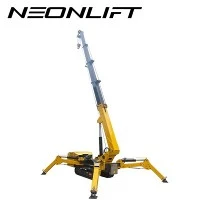
If you’ve ever stood at the base of a construction site, wind farm, or commercial building renovation and stared up at a telescoping manlift stretching toward the sky, you’ve probably asked the same question: How high can these machines actually go? As a supplier of telescoping manlifts, I get asked this all the time—from first-time contractors pricing out their first aerial lift to seasoned site managers planning multi-story projects. The answer isn’t a simple number, though; it depends on a mix of engineering design, safety regulations, and the specific type of telescopic manlift you’re working with. Let’s break it down, plus walk through what matters when choosing the right model for your height needs.
First, let’s define what a telescoping manlift is, just to get everyone on the same page. Unlike articulating boom lifts that bend like an elbow to reach around obstacles, telescoping manlifts (sometimes called straight boom lifts) use a series of nested, extendable arms that telescope straight up, giving them unobstructed vertical reach with almost no horizontal drift at maximum height. That makes them the go-to option for tasks where you need to reach straight up—like installing rooftop HVAC units, trimming tall utility lines, or accessing upper floors during high-rise construction.
Now, to the big question: maximum height. Most standard telescoping manlifts you’ll find for commercial and industrial use have a platform height (that’s the height of the work platform floor, not the base of the machine) ranging from 40 feet up to 185 feet. That translates to a total maximum reach from the ground of around 42 feet to 190 feet, depending on the model. But before you fixate on that 185-foot number, there are a bunch of factors that can make that height lower or even unsafe to reach—so the listed max height is more of a theoretical ceiling, not a hard-and-fast number you can rely on for every job.
Let’s start with the most important limiting factor: the machine’s lifting capacity at height. A telescoping manlift’s load rating drops the higher you extend its arms, because the further the arm stretches, the more leverage the weight of workers, tools, and materials puts on the base of the machine. For example, a mid-sized telescoping manlift with a 60-foot platform height might have a rated capacity of 500 pounds at full extension—enough for two workers and their tools. But a larger 120-foot model? It might only hold 250 pounds at maximum height, which is usually just one worker and small hand tools. If you overload it at height, the machine can become unstable, tipping or straining its structural components. That’s why our team at [Supplier Name] always emphasizes to customers that max height is only achievable when you’re within the machine’s weight limits, and with the platform centered over the base.
Next, the type of telescoping manlift itself plays a huge role in height capability. There are a few main categories, and each has different max heights. If you’re working on a smaller residential job or a tight commercial space, a towable man lift is a great option. These compact models are designed to be hitched to a work truck, towed to the job site, and set up quickly without needing a dedicated crane or heavy equipment transport. Most towable telescoping manlifts top out at around 50 to 60 feet of platform height, which is perfect for tasks like gutter cleaning, roof repairs on small to mid-sized homes, or exterior painting of single-story commercial buildings. If you need something even more compact for indoor jobs or smaller spaces, an electric man lift is another solid pick. Electric models are quieter, produce zero emissions, and are ideal for indoor construction or work in enclosed spaces like warehouses, with most electric telescoping manlifts reaching between 30 and 60 feet of platform height.


For heavier-duty, taller jobs—like high-rise construction, wind turbine maintenance, or large facility roof work—you’ll want to look at telescopic self-propelled platforms. These are the big workhorses of the industry, with powerful engines, reinforced arms, and heavy-duty bases that can handle extended heights. Some of our top-of-the-line telescopic self-propelled platforms we supply can reach up to 185 feet of platform height, which is equivalent to a 18-story building. That’s enough to reach the roof of even mid-sized high-rises, and enough vertical reach to access mid-facility areas on large industrial sites. We also offer vertical hydraulic aluminum alloy lift models for ultra-tall, specialized jobs, designed with lightweight but high-strength aluminum arms that minimize weight while maximizing height for jobs like utility line maintenance and telecommunications tower work.
Safety regulations are another non-negotiable factor that limits telescoping manlift height. In most countries, including the U.S., OSHA (Occupational Safety and Health Administration) sets strict standards for aerial lift design and operation. OSHA requires that all telescoping manlifts have load limit indicators that shut off the arm’s extension if the weight at height exceeds the rated capacity, plus outriggers that must be fully extended and stabilized before the arm can be extended past a certain point. On our machines, all these safety features are factory-installed and calibrated to meet OSHA standards, so you never have to worry about reaching a height that the machine isn’t designed for safely. We also provide full operator training with every machine we supply, because even the best-designed lift is useless if the operator doesn’t know how to adjust for terrain, wind, and load when reaching high.
Wind is a often overlooked factor that can put a hard cap on how high you can safely operate a telescoping manlift, even if the machine’s technical max height is higher. Wind speeds increase with altitude, so the further up your platform goes, the more force the wind will apply to the lift’s arm and the worker in the platform. Most telescoping manlift manufacturers set a maximum wind speed for operation—usually around 28 mph—at full height. If you’re working in an area prone to sudden wind gusts (like open construction sites or exposed mountain locations), you may have to limit your maximum height to avoid putting the machine at risk. We always advise our customers to check the daily weather forecast before using a telescoping manlift at height, and to avoid operation if wind speeds are approaching the machine’s safety limit.
Terrain and job site conditions also impact how high you can safely reach. Telescoping manlifts need a flat, stable surface to set up on—most require a slope of less than 2 degrees to deploy fully. If you’re working on uneven ground, like a gravel construction site or a sloped rooftop, you may need to use additional leveling devices or limit the arm’s extension to keep the machine stable. Our team works with every customer to assess their job site and recommend the right model, whether that means a smaller, more compact lift for uneven terrain or a larger model with heavier outriggers for flat, open sites.
Now, when is max height even necessary? A lot of customers come to us asking for the tallest telescoping manlift available, but that’s not always the most cost-effective or safe choice. If you only need to reach a 70-foot roof, investing in a 185-foot model is overkill—it will be more expensive to rent or buy, heavier, harder to transport, and less maneuverable on tight job sites. That’s why we always take the time to ask customers about their specific job requirements: what’s the maximum height they need to reach, how much weight they need to carry, if they’re working indoors or outdoors, and what their job site space is like. For example, a customer renovating a 60-foot office building will get more value out of a 60-foot electric man lift (link here: /aerial-lifts/man-lift/electric-man-lift.html) than a 120-foot model, because it’s easier to maneuver in the building and cheaper to operate. For a customer maintaining a 150-foot wind turbine, though, the telescopic self-propelled platform (link here: /aerial-lifts/man-lift/telescopic-self-propelled-platform.html) is the perfect fit, with enough height and power to get the job done safely.
Another common question we get: How do telescoping manlifts compare to other aerial lifts when it comes to height? Articulating boom lifts, which have jointed arms, can reach similar heights (some up to 180 feet), but telescoping models have a clear advantage for straight-up tasks because their arms don’t bend, so there’s no gap in reach at the top. For access around obstacles, articulating booms are better, but if you need straight vertical reach, telescoping manlifts are the way to go. We also supply aluminum work platforms (link here: /aerial-lifts/man-lift/aluminum-work-platform.html) for paired use with smaller telescoping lifts, providing extra space for tools and materials when you’re working at height.
At the end of the day, the maximum height a telescoping manlift can reach is a balance of engineering, safety, and job-specific needs. You don’t always need the tallest lift on the market—you need the lift that matches your job’s requirements for height, weight, maneuverability, and terrain. If you’re not sure which model is right for your project, our team is here to help. We’ve worked with construction companies, utility providers, telecom teams, and residential contractors across the country, and we can walk you through every factor to find the perfect telescoping manlift for your needs. Whether you need a compact towable man lift (link here: /aerial-lifts/man-lift/towable-man-lift.html) for small jobs or a heavy-duty vertical hydraulic aluminum alloy lift (link here: /aerial-lifts/man-lift/vertical-hydraulic-aluminum-alloy-lift.html) for large-scale industrial work, we have the models to get the job done safely and efficiently.
If you’re ready to discuss your project or ask more questions about telescoping manlift height, capacity, or available models, feel free to reach out to our team. We’re happy to provide detailed specifications, answer all your technical questions, and help you find the right solution for your next aerial work task.
References
- Occupational Safety and Health Administration (OSHA). Standards for Aerial Lifts, 29 CFR 1926.453.
- American National Standards Institute (ANSI). A92 Series of Safety Standards for Aerial Work Platforms.
- Telescopic Boom Lift Manufacturer Technical Specifications. 2024. Global Aerial Lift Industry Report.
- National Commission on Safety of Aerial Work Equipment. Guidelines for Load Rating at Height, 2023.