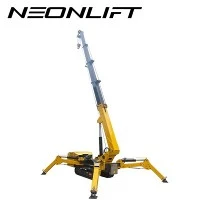
If you’ve ever watched a telescoping manlift extend its boom 50, 60, even 80 feet into the air to help workers fix a warehouse sign, wash storefront windows, or trim tree branches, you’ve probably wondered one thing: how the heck does that thing lift itself and a person way up there without grinding to a halt halfway? As someone who’s been supplying these lifts for years, I get this question all the time—most folks don’t expect a piece of equipment that big to run on anything other than a fancy power cord, but the answer’s a little more interesting, and a lot more practical, than that. Let’s break down what actually powers a telescoping manlift, why the right power source matters for different jobs, and how to pick the right one for your needs.
First, let’s start with the basics: a telescoping manlift (also called a boom lift, for those who mix the names up) isn’t just a single machine—it’s a collection of moving parts: the base that rolls around, the boom that extends out and up, the platform that holds the worker, and all the hydraulics that make it stretch. Every part relies on power, but there are two main types of power you’ll see on these lifts today: hydraulic systems (the workhorses, honestly) and electric power, with some hybrids popping up for specific jobs. Let’s go through each, because they’re not one-size-fits-all.
Most telescoping manlifts out there, especially the heavy-duty ones used on construction sites or outdoor commercial jobs, run on a hydraulic system powered by an internal combustion engine—usually a gas or diesel engine. Wait, hydraulics, you say? Yeah, that’s the secret sauce. Hydraulics work by using fluid under pressure to move parts, right? So the engine’s job isn’t to lift the boom directly—it’s to power a hydraulic pump that pushes fluid into the boom’s cylinders. Those cylinders have pistons inside, and when the pressurized fluid pushes the piston out, that’s what makes the boom extend upward. For the base, the same engine powers a drive motor that makes the wheels or tracks turn, so you can roll the lift from one side of a job site to another without having to haul it on a trailer every time.
Why do heavy-duty telescoping lifts use gas or diesel engines? Outdoor work, first off. If you’re on a construction site that’s got no access to power outlets, or you’re working at height where you need that extra torque to lift heavy materials (a bucket of roofing shingles, say, plus a worker), an engine-powered hydraulic system is way more reliable than electric. They’ve got the power to push big, bulky booms up to 80 feet or more, and they’re built to run for hours straight without dying. I’ve seen guys rely on diesel-powered telescoping lifts for full-day framing jobs, and they barely need a top-up before the end of the shift.
But wait, gas and diesel engines have a downside: emissions and noise. If you’re working indoors—like in a retail store during off-hours, or a warehouse that’s still storing inventory—those exhaust fumes aren’t ideal, and the engine’s noise would drive customers or workers crazy. That’s where electric-powered telescoping manlifts come in, and a lot of people don’t even realize there are good options for indoor jobs now. Electric lifts run on rechargeable batteries—usually lead-acid or lithium-ion, which last a lot longer than they used to—and they power the same hydraulic pumps, just without the combustion engine. No fumes, no loud rumbling, and they’re way quieter, which is perfect for indoor or low-noise jobs.
Lithium-ion batteries, specifically, have been a game-changer here. A few years back, electric lifts would die halfway through a shift if you used the boom much, but now, a good lithium-powered telescoping lift can run 8-10 hours on a single charge, which is enough for most indoor jobs. And they charge way faster too—some top up to 80% in an hour, so you can charge them during lunch and get back to work. That’s why a lot of my clients who do maintenance in office buildings or malls swear by electric lifts now.
There’s also a hybrid option, which is becoming more common for jobs that bounce between indoor and outdoor work. A hybrid lift has both a small gas or diesel engine and a battery, so you can run electric indoors for quiet, low-emission work, and switch to engine power when you’re outside on a big job that needs extra reach or runtime. It’s like getting the best of both worlds, and they’re super popular with contractors who do a mix of commercial and residential work.
Wait, but hold on—power source isn’t just about lifting the boom. It’s also about the small stuff that makes the lift useful: the drive system, the platform controls, even the lights. For example, if you’re looking for a compact lift to work in tight spaces, like a narrow warehouse aisle, the power source needs to be precise too. That’s why I always point clients to our One Man Drivable Lift if they’re working in tight spots—small, electric, easy to maneuver, and perfect for one person. You don’t need a big gas engine taking up space when you’re squeezing between shelves.
And it’s not just about where you’re working—it’s also about the weight you’re lifting. A telescoping manlift’s power source has to handle the total load: the worker, their tools, maybe a few extra materials. A diesel-powered lift can handle way more weight than an electric one, right? Because the engine can produce more torque. That’s why for construction jobs where you’re lifting 500 pounds of lumber plus a worker, you need an engine-powered model. For window washing on a high-rise office building, though, electric is fine because you’re just lifting one person and a bucket of soap.
Another thing to consider: maintenance. Engine-powered lifts need regular oil changes, air filter checks, and fuel top-ups. Electric lifts just need battery checks and occasional cleaning of the connections, which is less work for you. I tell clients who don’t want to deal with engine maintenance to go with electric, especially if their jobs are mostly indoor. But if you’re running a job site where you’re going through a lot of lifts and need something tough, engine-powered is the way to go.
Wait, let’s not forget about other types of manlifts that are related, but telescoping ones are a bit different. For example, some people mix up telescoping manlifts with scissor lifts, but scissor lifts use a different lifting mechanism—they have crossed supports instead of a boom that extends out. But the power source for both is similar: hydraulic, either engine or electric. That’s why a lot of our Hydraulic Aluminium Lifts, which are smaller, compact, use the same hydraulic system, just scaled down for lighter jobs.
What about the surfaces you’re working on? If you’re on a sensitive floor, like a tiled mall floor or a hardwood warehouse floor, you don’t want a heavy diesel lift that leaves marks. That’s where lightweight electric models come in—they’re lighter, so they don’t damage floors. I’ve recommended our Floor-Friendly Crawler Vertical Lift for that kind of work, because it has crawler tracks instead of wheels, so it distributes weight evenly and won’t scratch even delicate flooring.


And for jobs that are on uneven ground, like a residential yard with sloped grass, a diesel-powered telescoping lift is better because it has more torque to handle uneven terrain. Electric crawler lifts are good for flat indoor or paved outdoor jobs, but if you’re dealing with hills or soft ground, the engine’s power is what keeps the lift stable.
Let’s get back to the original question: the power source of a telescoping manlift. At the end of the day, it’s hydraulic power, but the energy that drives that hydraulic system comes from either a gas/diesel engine, a battery, or a mix of both. The right power source depends on your job, where you’re working, how much weight you need to lift, and how much maintenance you want to do.
A lot of first-time buyers make the mistake of just picking the cheapest lift, but that’s where they go wrong. If you buy a tiny electric lift for a construction site where you need to lift 60 feet up, you’re gonna get stuck halfway, and that’s a safety hazard. If you buy a big diesel lift for indoor office work, you’re gonna deal with fumes and noise complaints. That’s why I always ask clients a few questions before I recommend anything: where are you working? How high do you need to go? What are you lifting? That helps me point them to the right model, like our Mobile Telescopic Man Lift for outdoor medium-height jobs, or our Double Mast Aluminum Alloy Lift for indoor jobs that need a bit more reach than a single-man lift.
Over the years, I’ve seen the power sources for telescoping manlifts evolve a lot. Ten years ago, electric lifts were flimsy, short-lived, and not good for anything more than 30 feet of height. Now, lithium-ion batteries have changed that—they’re lighter, last longer, and power bigger lifts. Hybrids are getting better too, so you don’t have to sacrifice power for eco-friendliness. It’s exciting to see how the technology has caught up to what workers actually need.
If you’re in the market for a telescoping manlift, don’t just look at the height or the weight capacity. Ask about the power source. Think about your job: are you working indoors or outdoors? Do you need to move around tight spaces? Do you care about emissions and noise? Those are the things that will make your lift useful, not just a big piece of equipment that sits in your garage half the time.
Whether you’re a contractor who does a mix of jobs, a facility manager who maintains office buildings, or a homeowner who needs to trim trees, there’s a telescoping manlift power source that fits your needs. I’ve supplied everything from small electric single-man lifts to big diesel-powered boom lifts for construction sites, and I can tell you there’s no one-size-fits-all answer. The key is to match the power source to your specific job, not the other way around.
If you’re ready to chat about what power source works best for your next project, or want to see the different models we have, reach out to our team to talk through your needs. We’ve got options for every job, whether you need a compact one-man lift for indoor work, a heavy-duty diesel lift for construction, or a hybrid that does it all. Don’t hesitate to connect—we’re here to help you pick the right lift, and the right power source, so your job goes smoothly.
References:
- National Commission on Industrial Safety. (2022). Aerial Lift Power Sources and Workplace Safety. Occupational Equipment Standards Journal.
- International Organization for Standardization. (2021). Safety Requirements for Telescoping Boom Lifts. ISO 18878:2021.
- Battery University. (2023). Lithium-Ion Batteries in Construction Equipment. Tech Briefs for Industrial Applications.
- U.S. Occupational Safety and Health Administration (OSHA). (2020). Hydraulic System Maintenance for Aerial Lifts. Equipment Safety Guidelines.