If you’ve ever stood at the base of a construction site, a tree trimming job, or even a building maintenance project, you’ve probably glanced up at those towering boom lifts and thought: “How high do those things even go?” As a boom lift supplier, I get this question all the time—whether it’s from a new contractor testing their gear for the first time, a homeowner tackling a roof project, or a facilities manager sizing up window replacement for a 20-story office. The vertical reach of a boom lift isn’t just a random number, either; it’s the backbone of how you pick the right machine for your job, avoid costly delays, and stay safe up high. Let’s break this down, lay out the science behind the numbers, and even tie in the right lift options for every height need along the way.
First, let’s get one basic definition out of the way: vertical reach (also called “working height”) is the maximum distance from the ground to the platform’s floor when the boom is fully extended straight up. It’s not the same as “platform height,” which is how high you (the operator) can stand—add about 6 feet to the vertical reach number, since most people are under 6 feet tall, and that’s the standard clearance the industry uses. For example, a boom lift with 30 feet of vertical reach gives you roughly 36 feet of platform height, and one with 100 feet of vertical reach gets you about 106 feet up. That’s a key detail to remember because it’s the number you’ll actually use to plan your job.
Now, why does vertical reach matter so much? Let’s say you’re a painter touching up the eaves of a 4-story home. A 20-foot vertical reach lift would give you only 26 feet of platform height—way too short for that 35-foot eave, so you’d end up renting twice or climbing a ladder, which is way less safe. On the flip side, grabbing a 150-foot vertical reach lift for a 30-foot sign installation is overkill, and you’ll waste money on a machine you don’t need. That’s where matching the vertical reach to your job’s specific needs comes in, and that’s exactly what I help my customers nail down every day.
So, what’s the actual range of vertical reaches across different boom lifts? Let’s start with the smaller, more compact models, because they’re super popular for tight spaces. If you’re working in a residential backyard, a narrow hallway, or a crowded urban sidewalk, you don’t need a giant lift that won’t fit through a standard 36-inch doorway. That’s where a Compact Boom Lift comes in. These little workhorses usually have vertical reaches between 20 feet and 40 feet. Don’t let their small size fool you, either—many of them can lift 500 pounds (plenty for one person plus tools) and can navigate uneven ground thanks to tight turning radii. Perfect for things like gutter cleaning, small tree trimming, or interior work in warehouses with low overhead beams. If your job’s inside or in a tight spot, this is the starting point for figuring out your vertical reach needs.
Next up, if you need a little more height but still don’t want to mess with a big, bulky lift that needs a dedicated spot to set up, a Trailer Type Lift is a solid choice. As the name suggests, these mount to a standard trailer hitch, so you can tow them with a pickup truck or SUV and set them up on-site in 10 minutes or less. Their vertical reach starts around 30 feet and goes up to about 60 feet—great for things like streetlight maintenance, small commercial roof repairs, or even holiday light installation on large properties. They’re also a favorite for event setup crews, since you can tow them to a concert venue or fairground without needing a full delivery and setup crew. I see a lot of first-time contractors go for these because they’re affordable, flexible, and easy to use for one-person jobs.
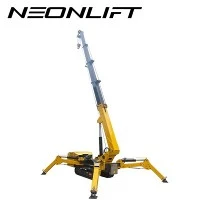
Now, if you’re dealing with taller projects—like multi-story building exterior work, large tree removal, or industrial maintenance on equipment that’s 80+ feet off the ground—you’ll need a lift with more vertical punch. That’s where the industrial line comes in, specifically the Industrial Mobile Spider Boom Lift. These bad boys are designed for heavy-duty work and can handle vertical reaches from 50 feet all the way up to 185 feet. Wait, 185 feet? That’s the height of a 15-story building—crazy, right? What makes spider lifts unique is that they have outriggers that stabilize them on uneven or soft ground, so you can use them on construction sites, wooded lots, or even rough terrain where regular boom lifts can’t safely set up. They’re also narrow enough to fit through most construction gate openings, which is a big plus for jobs in dense urban areas where space is at a premium. I’ve seen these used for everything from bridge painting to installing rooftop HVAC units on 12-story apartment buildings.
Let’s not forget about power sources, because that can actually limit the vertical reach you can use in certain environments. If you’re working indoors, in a warehouse, or in a residential neighborhood where noise or emissions are a concern, a zero-emission option is a must. The Zero Emission Electric Aerial Work Platform has vertical reaches that range from 20 feet to 150 feet, and since they run on rechargeable batteries, they don’t produce fumes and are way quieter than diesel-powered lifts. That makes them perfect for indoor jobs like electrical repairs in malls, painting office interiors, or working in hospitals where exhaust fumes are a no-go. Even the big, high-reach electric models can go toe-to-toe with diesel ones when it comes to vertical height, so you don’t have to sacrifice reach for eco-friendly operation.
Wait a second, what about that “Hydraulic Cherry Picker” I mentioned earlier? A lot of people use “cherry picker” as a generic term for any boom lift, but technically, hydraulic cherry pickers are a subset of boom lifts, usually the smaller to mid-range models with vertical reaches from 20 feet to 60 feet. They get their name from the old-fashioned cherry pickers used in orchards, and they’re super common for residential and small commercial jobs because they’re easy to operate and maintain. Most have hydraulic systems that let you move the boom up, down, and side to side smoothly, so you can get right up to the spot you need without banging into walls or tree branches. I usually explain to customers that if you hear someone say “cherry picker,” they’re probably talking about a smaller, hydraulically operated boom lift for light to medium work.
Now, let’s talk about the factors that actually determine a boom lift’s vertical reach, because it’s not just a number printed on the side of the machine. First, there’s the boom type: most boom lifts use either articulating (jointed) booms or telescopic (straight) booms. Articulating booms have hinges that let you reach over obstacles, like a tree or a wall, while still getting height, and their vertical reach is usually a bit less than telescopic booms of the same size. Telescopic booms have a single, straight boom that extends like a telescope, so they can reach higher straight up, with vertical reaches over 180 feet for the largest models.
Next, there’s the lift capacity, which directly ties to vertical reach. A big boom lift that can lift 1,000 pounds (two people plus heavy tools) won’t be able to reach its maximum vertical height if it’s carrying too much weight. For example, a 120-foot vertical reach telescopic lift might only reach 100 feet if you’re carrying two adults and 200 pounds of material, because the extra weight puts strain on the boom and limits how far it can extend. That’s why it’s super important to check the lift’s capacity chart, not just the maximum vertical reach number, when you’re planning your job.
Ground conditions matter too. If you’re setting up a boom lift on soft dirt or uneven ground, the outriggers (for larger models) have to be extended properly to keep the machine stable, and that might slightly reduce the maximum vertical reach. Even a small Compact Boom Lift will shift if it’s on a sloped surface that’s over the manufacturer’s recommended limit, which can limit how high you can safely go. I always tell customers to survey their on-site ground conditions before choosing a lift—if it’s a construction site with rough dirt, a spider lift with outriggers is way safer than a straight boom lift that needs a flat, concrete pad.


Another common question I get: can you adjust the vertical reach on a boom lift? The short answer is no, but you can adjust the platform height by varying how far you extend the boom. You don’t have to go all the way up—if you only need 40 feet for a sign installation, you can set the boom to extend to 40 feet instead of the maximum 50 feet, which saves on wear and tear on the machine and even a little on fuel (if it’s a diesel model). That’s a good tip for small jobs—don’t crank the boom all the way up if you don’t need to, it just makes the job less stable and wears out parts faster.
Now, let’s bring this back to real-world examples, because that’s what makes this stuff make sense. Last month, I worked with a tree service company that needed to remove a 80-foot pine tree from a residential backyard. They thought they needed a 100-foot vertical reach lift, but when we surveyed the yard, there was a 10-foot stone wall between the driveway and the tree, and the ground was soft from recent rain. We recommended an Industrial Mobile Spider Boom Lift with a 120-foot vertical reach. It had outriggers that could stabilize on the soft dirt, and the articulating boom let them reach over the wall to cut branches without damaging the stonework. They ended up using only 75 feet of vertical reach, which was perfect, and the job took half the time they thought it would because the lift was exactly the right size.
Another example: a local bakery needed to paint the 2nd and 3rd floor eaves of their 3-story building, and they were hesitant to rent a big lift because the alley behind the building was only 4 feet wide. We suggested a Compact Boom Lift with a 35-foot vertical reach—it was narrow enough to fit through the alley gate, and the 35-foot vertical reach gave them 41 feet of platform height, which was enough to reach all the eaves. They loved it because it was cheaper than a larger lift, and it didn’t block the alley for other businesses.
So, if you’re trying to figure out the right vertical reach for your next job, start with these three steps: first, measure the exact height you need to reach (don’t guess—climb a ladder or use a tape measure to get an accurate number, then add 2-3 feet for maneuvering room). Second, check your on-site conditions: is it tight? uneven? noisy? That will narrow down whether you need a compact, trailer type, spider, or electric lift. Third, factor in the weight you’ll be carrying—if you’re hauling heavy tools or two people, you might need to go for a lift with a little more reach or capacity than you initially thought.
At the end of the day, the vertical reach of a boom lift is a critical detail that can make or break your job—too short, and you’re stuck with ladders or unfinished work; too tall, and you’re wasting money and risking safety. As a boom lift supplier, my whole goal is to help you pick the right lift for your exact needs, whether you’re a small homeowner with a one-time yard job or a large construction company working on a 20-story building. If you’re not sure which reach is right for you, feel free to reach out to talk through your project details.
References
- International Powered Access Federation (IPAF). “Aerial Work Platform Safety & Specifications Guide,” 2023.
- Manitou Group. “Boom Lift Vertical Reach & Capacity Standards,” 2022.
- United States Occupational Safety and Health Administration (OSHA). “Powered Industrial Trucks and Aerial Lifts General Requirements,” 2021.
- Genie Industries. “Compact and Specialty Boom Lift Performance Data,” 2023.